informant38
.

-
...But of these sophisms and elenchs of merchandise I skill not...
Milton, Areopagitica

Except he had found the
standing sea-rock that even this last
Temptation breaks on; quieter than death but lovelier; peace
that quiets the desire even of praising it.

Jeffers, Meditation On Saviors


-

6.2.05

Martin Mubanga says they tried to recruit him before shipping him off to the south-eastern tip of Cuba and the US naval installation there. "They" being somebody from the American intelligence community and someone from its British counterpart.
Some questions about that:
Did/do they stop trying to recruit people after they get them to Guantanamo? Mubanga's story is resistance all the way, surely out of the thousands of processees there are those who buckle, who take the main chance for what it's worth. And what are they like now? What are the aspects of their utility? Where would they be sent to practice their new-found skills? Is it too fantastic to speculate that the same bizarre techniques and technologies that are being used to break prisoners don't have their analogs in the rebuilding of personality? In the redesigning of human beings that were already deemed expendable. And that even more appalling things than the sadistic tormenting of helpless men are the result.
Once morality's dispensed with we're looking at biology, and - as I've been saying for a while now - something that amounts to a species split, a branching away from what seemed to be the immutable human template. Cain and Able struggling toward all or nothing. Or - syphilis flashing back its mutating colors at the immune systems of its hosts.
-
Also what does Guantanamo - and its franchises and subsidiaries, and its parent organization, tell us, or hint to us or speak directly to us in dumb-show symbolism - about the American prison system? Is it really possible to think of this anti-human behavior as unique to the military? Why? It isn't a military phenomenon, any more than the arresting of homosexuals was once a police phenomenon. These agencies are the enforcers of a larger moral context, and that moral context is itself the shield and flag of a biological nucleus; a human thing different from the human things it's trying to metabolize, for whom the dross and waste of the lives of those it views as imperfect are meaningless, weightless, except as something that needs to be trimmed away. We can see how the pattern of the Holocaust is playing out inside the mirror, with the creatures that were formed in that crucible now operating the levers and gears.
Out of the chaos and horror, as it subsides, emerge the creatures that will now owe their lives and their form to that horror. The strengthened immune systems that are left after the plague subsides, the quickness and agility of the ones who don't get eaten - this is what's happening, or about to, and knowing that will strengthen the ones who are now prey. That explains why there's so much energy devoted to making sure the prey doesn't begin to understand where it is, and what's happening to it.
Evolution? Nonsense! Back in line, all of you!
-
It is a moral contest. But the letter of the law is not what the contest's about. Morality is there to strengthen biology, not refute it.
-
-
The other thing I've been meditating on is the 360 degree circle versus the 365 day year. Imagining an earth in a perfected orbit. Wondering if, as with the language, there aren't clues built-in to the symbols; and, as with the language, wondering how many of those clues and symbols have been corrupted and bent to the service of the thing that now controls most of the human world's energy.
Moving Venus out to near-earth orbit, only at 360 on the dot. What does that give us? It shines, to me, it has a glow. I don't mean doing that, that seems hubristic past redemption, but the idea of a world in that orbit, as a result of the "natural" processes of the solar system.
Wondering if Velikovsky's "Worlds in Collision" explains the bloom of gigantic creatures, the planet smacked by "asteroids", shoved around, the broken crust and the mass extinctions, sudden climate shift, with the earth after one of these altercations a little farther from the sun, enough that the gravity field is that much weaker.

4.2.05

Half of all personal bankruptcies in the United States
are now caused by soaring medical bills.

Axis of Logic

KWSnet went blank without advance notice or warning.
Now Countercurrents has gone dark.

3.2.05

More notes:
Two strategems of cowardice that seem to be insurmountably effective.
Children as shields. In one the attacker uses his own children as a shield, so that your defence against his attack becomes an attack on his children because he's shielding himself behind them.
In the real world this shows up as:
American political and military actions that cause harm and suffering.
America a nation of 300 million is governed by less than ten thousand men in toto, and about seven or eight hundred men in fact. The actions and the results of the decisions these men make affect people who haven't the sophistication and experience necessary to see them as coming from a minority hiding behind the majority of Americans, and they react accordingly, hating Americans. The people of America are the children of their leaders.
-
In the other strategem he gets your own children and shields himself with them as he attacks you.
In the real world this shows up as:
In order to feed your kids you can't separate from the economy. The convolutions of this are that the economy is somehow neutral, which is horseshit, and that the economy is somehow at worst morally neutral, and at best a system of rewards for good behavior, which is total horseshit. The economy, or an economy, is going to reward certain behaviors and certain types of people. When, as in the present time, you have a suicidal and toxic economic system, you're forced to choose between giving your children as good a nutritional and emotional upbringing as you can, which can only mean selling out, participating, or making some kind of principled stand which will amount to a kind of slow martyrdom at best and imprisonment, or worse, at worst, and will mean suffering for the family.
-
As always the miracle seems to be the continued presence of good and decent people, against staggering odds.

1.2.05

A socially neutral tragedy?

Images of the 2004 tsunami, appearing along with news of Iraqi resistance and US missions of "freedom and democracy", remap Asia onto a visual regime that reappears, not as farce, but as tragedy. A new Asia that affirms every old stereotype of the First World emerges in the US media, complete with inept governments, docile suffering populations, political insurgencies, and catastrophic natural disaster. When assisted by a benevolent West, poverty-stricken natives are able to tap into their inherently ennobling innocence, resilience and flexibility, but only when washed clean of their inherent tribal animosities with a dose of Christianity.

As we critique the naturalization of a helpless Asia in global media images, we must enlarge our critique to include not merely the colonial legacy of "underdevelopment", but also the present unevenness of the neo-liberal economic and political world order. The images of the refugee camps in Chennai that now find their way into prime-time US television must not eclipse the fact that India actively plunged into the "informatization route" to development beginning with Rajiv Gandhi and Sam Pitroda. Investing heavily in communication technology from the late 1980s, India signed on global information technology agreements that clearly benefited only its upper classes. The information crisis that created India's unpreparedness for the tsunami was neither natural nor inevitable. As an Indian Express story revealed, the Indian Meteorological Department (IMD) in Port Blair, Andamans, had only an old analog system rather than a digital one; it printed out a blank piece of paper because the scale of the earthquake and its aftershocks exceeded the range of its calibration. Why had a nation which takes pride in its cyber czars and cyber "coolies" not updated the Andamans geophysical equipment?

Even more ironic, the first IMD communique went to the residence of former science and technology minister Murli Manohar Joshi, rather than his successor, Kapil Sibal. No coastal warning was issued. The Indian state and information technology multinationals make their choices, shaped by national priorities, about which fields of technology they should invest in. This may change now that tsunami-warning systems are a budget priority, but there were numerous opportunities to make this allocation earlier, when free-market development priorities demanded that money go to the cyber medicos in Bangalore who read X-rays of American patients from Boston, Massachusetts, in minutes and the call centers that ensure 24-hour productivity for the West.

The information fiasco in the hour that preceded the waves that hit the Tamil Nadu coast was a classic case of the gaps - structural, not accidental - produced by neo-liberal underdevelopment. The heavy infrastructure investments to facilitate multinational information-technology (IT) investment, the reduction of tariffs that made India's white collar labor pool attractive for IT outsourcing, the Rupert Murdoch-style media globalization that created huge markets for corporate lifestyle brand products: these and other Indian economic trends point to the new world order's valuation of information systems as commodities rather than as potentially transformative social practices. Sadly, the disaster of the world information economy that the decolonizing world sought to prevent 30 years ago has now become the nightmare in which we live. As the sea waters clear, one wonders to whom the windfalls of the disaster will accrue: the Indian government has now asked Microsoft to digitize its collection of satellite images, remote sensing data, and information about the country's terrain.

The devastation caused by the tsunami was by no means uniform across caste and class. Watching victims' grief on American television screens, Western viewers were given no way to understand the distribution of tragedy - it seems like cruel fate that those who've lost entire families are the poor. Little wonder that even the well-intentioned turn to mystified religious explanations or assumptions of the inherent abjectness of the Third World.

Coastal demographics in South Asia invert the Western neighborhood model. While the super rich enjoy ocean views on California and Cape Cod coasts, it is the poorest and the most marginalized South Asians who populate the beaches of the sub-continent. Fish workers have long been ostracized both because of their low position in the caste hierarchy and because of their economic marginality. Despite having some of the richest ocean resources in the world, fish workers have suffered the effects of neo-liberalization more cruelly than most, while middle men and fishery multinationals have monopolized value-additive processes and profits from the fishing industry. Despite the fact that fish workers live by a complex science, and continue to call for access to more environmental data, the assumption is that low-caste poor sectors have little to do with science and technology. Social policy organizations "deal with" the fish workers' unrest when it explodes onto the streets, but funding is reserved for those middle-class scientific and environmental priorities: high tech, high finance and the saving of large endangered species capable of building tourist revenue.

Particularly disturbing in the aftermath of aid flows is the way in which the disaster is being deployed to cast the coastal communities into long-term debt traps. The Kerala government has struck a deal with insurance companies to provide loans to coastal residents: Rs5,000 (US$114) as a loan to each tsunami-affected family at 7% interest – all at a time when international aid is flowing in as interest-free capital to those who can control these transnational flows. The money will indirectly flow back to the those who have it, because another Rs6,500 will be given for purchasing consumer durables at 4% interest. Again, each affected person will also be eligible for a loan of Rs75,000 for purchasing boats and fishing gear. These loans will carry an interest of 7%.


30.1.05

More notes:
The anti-smoking temperance movement has set the stage for the big denial scam that is so necessary to get little folks to take the fall for global warming so-called. Taking responsibility for your own actions means you choose to smoke and be addicted or you choose not to. Not a whisper about how we live in a community that's whipped and goaded dawn to dusk by bright flashing smiles and seductive come-ons that seem to originate in the air before our eyes. Not a word about the steady chant of "do this do this do this do this" that rolled out of the grandmother-box the TV was and is, the wolf-box that ate all our grandmothers. The same tools that were used to get people to smoke were used to get them to stop without once any mention of that process itself and the wielders of that being responsible for anything. Like the devil whining at God that he just offered they didn't have to take the deal on the terms displayed. Cars are like that, especially now in America. Big bad gas-drinking nightmares like living rooms where the kids feel right at home, and when the truth comes pouring down out of the sky, the scam's all ready to click right in, you did it to yourselves, you chose this, blind as you were it was your selfishness and bad choosing that did it. Like there's no one there inside that box. No grandma, no wolf, just air and all this flashing light that sounds human, so human, when it tries to sell you something you already want.

27.1.05


The five isolated tribes of India's Andaman and Nicobar Islands have survived the tsunami, despite being close to the epicentre of the earthquake. The Sentinelese, who have no contact at all with outsiders, and the Jarawa and Shompen, who have very little contact, all escaped relatively unharmed.

The two smallest tribes, the Onge and Great Andamanese, apparently knew that, on seeing the sea suddenly recede, a tidal wave was likely, and so fled to high ground. Sadly, the most numerous and assimilated tribe, the Nicobarese, were badly affected and many are feared dead. Survival has produced briefing papers for journalists reporting on the Andamanese tribes, emphasizing that they are neither 'primitive' nor 'Stone Age'. Unlike almost everyone else affected by the disaster, the isolated Andamanese tribes do not appear to need outside aid.

25.1.05

"But the question is," he concluded, "will the world ever learn?"


Dissection Room, Sachsenhausen
-


Deportes devant le portail du camp de Sachsenhausen
-

Unfortunately for the SS, homosexuals could not be identified as easily as Jews or Communists. Non-German gays were not incarcerated. Since Himmler believed that homosexuality destroyed societies, he thought it beneficial to allow Polish, French, and other non-German gays to remain implanted in their respective cultures-so long as they did not seduce German males. Homosexuals (who were caught) suffered from a mortality rate drastically higher than any of the other incarcerated groups. Those who were caught received the most brutal treatment of anyone in Germany."
excerpt from The Forgotten Holocaust Victims
Philip De Rochambeau
A History of The Holocaust
Father Ryan High School Nashville, Tennessee
-

-

"I saw quite a number of pink triangles. I don't know how they were eventually killed. ... One day they were simply gone."
-

-
"Our work, then, was as follows. In the morning we had to cart the snow outside our block from the left side of the road to the right side. In the afternoon we had to cart the same snow back from the right side to the left. We didn't have barrows and shovels to perform this work either, that would have been far too simple for us 'queers'. No, our SS masters had thought up something much better.

"We had to put our coats with the buttoned side backward, and take the snow away in the container this provided We had to shovel up the snow with our hands -- our bare hands, as we didn't have any gloves. We worked in teams of two. Twenty turns at shovelling up the snow with our hands, then twenty turns at carrying it away. And so, right throught the evening, and all at the double!

"This mental and bodily torment lasted six days, until at last new pink-triangle prisoners were delivered to our block and took over for us. Our hands were cracked all over and half frozen off, and we had become dumb and indifferent slaves of the SS.

"I learned from prisoners who had already been in our block a good while that in summer similar work was done with earth and sand. "Above the gate of the prison camp, however, the 'meaningful' Nazi slogan was written in big capitals: 'Freedom through work!'"

Furthermore, homosexuals were at another important disadvantage. They lacked the group support within the camp to maintain morale. As Lautmann observes:

Death rates for homosexuals were much higher, perhaps three to four times higher, than for other non-Jewish categories of prisoners. While their overall numbers are small, their fate in the camps more nearly approximates that of Jews than any of the other categories, except, perhaps, Gypsies. And, homosexuals did not survive for very long. Of those who were exterminated, most were exterminated within the first few months of the camp experience.
Only three categories of homosexual victims of the Nazi regime can be identified with any accuracy: (1) those arrested, sentenced, and executed for homosexual acts; (2) those who were sent to forced labor or concentration camps for homosexual acts and died there; (3) those put to death as part of the program of euthanasia because they had been committed to institutions as homosexual. All others -for example, those who committed suicide -can never be statistically identified or calculated. Also falling outside this figure are those who were permanently mutilated -castrated or sterilized against their will. It must be conceded that analyzing the losses inflicted upon the male homosexual community in Germany and the territories annexed to the Reich is fraught with formidable difficulties. There are simply no census data comparable to those utilized to determine the demographic movement of ethnic or religious communities, not even a "taxonomic" survey of homosexuality in the German population in 1932 and again in 1946. The whole problem of homosexual "identity" is far from being resolved, so that for past epochs a precise demarcation of membership in the community in question is probably impossible.

In sum, Heinrich Himmler was the chief architect of the persecution of male homosexuals in the Third Reich. He was motivated by the belief that a small number of constitutional homosexuals were infecting the rest of the German male population and causing it to withdraw from the breeding pool, and also that homosexuals formed conspiratorial cliques opposed to the policies of the state. He used the SS and police to identify and intern an unknown number of homosexuals in concentration camps. In addition, between 50,000 and 63,000 men were convicted in the regular courts of homosexual offenses. The wave of persecution peaked between 1937 and 1939 and declined thereafter. Most of the homosexuals who died in the concentration camps were victims of overwork, starvation, brutality, and general mistreatment. As a matter of policy, German nationals were not sent to the East for gassing, and this applied also to the homosexual German prisoners. The total number of victims (those incarcerated minus survivors) remains unknown, since no estimates have been made on the basis of the surviving records. Although Lautmann's figure of 5,000 to 10,000 homosexuals incarcerated in the camps may be low, in general it probably reflects the approximate maximum number of homosexual camp victims.

After the war, public opinion, horrified by Nazi crimes against humanity, remained indifferent to the treatment of homosexuals. Thus the West German government denied compensation to those homosexuals who survived the camps and prisons. Further, when the West German Constitutional Court reviewed the constitutionality of the Nazi version of Article 175 in 1957, it upheld the law -ironically, it did so on the 24th anniversary of the burning of the library of Hirschfeld's institute. The court cited legal documents from as far back as 1869 to justify the assertion that "homosexual acts unquestionably offend the moral feelings of the German people." Hence, in a rather extraordinary reversal of the conventional line, the court ventured to place the blame for past and continuing persecution of homosexuals collectively upon the shoulders of its own people. Thereafter West German judges made the application of Article 175 even more punitive. When in 1960 the validity of the 1935 version of Article 175 was challenged before the European Court of Human Rights in Strasbourg, it was affirmed with a brief assertion that the state has the right to infringe the privacy of its citizens "for the protection of health and morality."
-
Paragraph 175:
Wikipedia
US Holocaust Museum
University of South Florida
-

-
The gay men 'lucky' enough to be liberated from Sachsenhausen at the end of the war were then imprisoned for the remainder of their sentence. They were, after all, still guilty of committing homosexual acts. In December 2000, the German parliament officially apologised to gays and lesbians who were persecuted under the Nazi regime. They also expressed regret for the 'harm done to homosexual citizens up to 1969' for it was only then that Paragraph 175 was repealed.

Train To Sachsenhausen
David Swatling
Radio Netherlands
-
"But if the liberation of Auschwitz marked the beginning of the end of the Holocaust, it did not mark the end of the evil that spawned it," he said in the text of his speech.

"For today, even in societies like Canada, where respect for others is a value, world society is facing new threats of hatred that we must see as challenges to our values. More than ever, we must reaffirm our common values of inclusion and we must firmly reject all forms of hatred."

speech to the U.N.
commemorating the 60th anniversary of the liberation of Auschwitz
Elie Wiesel
Tornto Globe and Mail, 25.Jan.05

24.1.05

I'm sorry I'm just having a little trouble right now with this Cuba thing, where it's this horrible place of no freedom and no rights and all dictator tyranny and it's an island and at the south-east tip of the island that Cuba is there's an American military base where Iraqi and Afghani and other brown people are taken and tortured and reprogrammed and who really knows what else they have done to them or even who they are all of them. And Cuba is a bad place. But there's an American military base there. What it reminds of for no reason I can discern is this thing I read one time by this guy who was in other respects pretty much an outlaw or a biker renegade or whatever and he was talking about when he was a kid and how his dad was fucking his sister and both his mom and dad were beating up him and his brothers and his sisters and then there was this argument of some kind and everything got critical and volatile and his sister came out of the back of the house where the bedrooms were and she had this used condom held dangling from her hand and even though it was something everyone in the family knew they all had the ability to live as though they didn't really and also there's a natural thing I think of living when you depend on food and shelter coming from whatever it is that becomes exempt in some ways, it requires a sacrifice, a risk of everything, and what he was saying is his sister took that risk no going back this is it, all her shame and the little bit of comfort denial gave her she threw it right out into the sun and no going back this was it, the nucleus of the family was broken open and would never get repaired.
I don't know why, but Cuba and Guantanamo remind me of that.
Today.


More notes:

The Puritan campaign to eradicate smoking seems pretty successful, and it should be, since it's using all the same tools of coercion and subliminal command/suggestion that caused people to take up smoking to begin with - to get them to quit and/or not take it up; but I still can't reconcile all this concern with the pure lungs of children, and public health as far as smoking goes - with absolute silence from the same moral combatants - concerning the automobile.
All these big-number statistics, a million deaths a year from smoking, a million two hundred thousand deaths a year from traffic worldwide - still the assumption behind the graph is that all those deaths are units, vanishing from a mechanical landscape, like ball bearings or pencils in a factory or a school. The unspoken assumption being they're all replacable because they're statistically interchangeable. One death equals another in the moral combat of the moment.
But smoking, when it does kill kills the mature, the middle-aged, the old almost exclusively. I'm not suggesting that's alright, I'm suggesting the emphasis on the evils of smoking is cowardice in the face of a larger, invincible opponent that's attacking the center of what we are, not the edge.
Traffic death is the largest killer of people under 30 in the US.
Smoking is trivial compared to that, meaningless in the face of that, perpipheral and unimportant, as unhealthy as it may be. Just as, whether you want to admit or not, the death of a child is more weighted, more important than the death of an old man, generally.
More children are dying on the road from "accidents" than from any single other cause, right now in the US, and these brave moral soldiers have spent years and millions of dollars attacking the evils of smoking. Congratulations, heroes! Well done!
And those are random deaths in traffic, unconnected to any behavior or genetic configuration. Except in the larger context, where the behavior is being in the car as opposed to walking or some other form of transportation, and the genetic configuration is being in a family that has adapted to a world overrun with steel and poisonous gases.
So we have these champions of children bravely taking down the tobacco companies - though they haven't really, just diverted their corporate focus to other parts of the world and other products - and creating a solid wall of contempt toward the practice of tobacco comsumption, especially among the young.
While death thins the ranks of the young and healthy like an untouchable aristocrat, choosing his little disposable playthings from the streets as he passes.

20.1.05

The moral choice between oppression, which is always wrong,
and freedom, which is eternally right.

"When the Declaration of Independence was first read in public and the Liberty Bell was sounded in celebration, a witness said, 'It rang as if it meant something.' In our time it means something still."

George W. Bush, Inaugural Address, 20.Jan.05
full text at Aljazeera.net

-
The Liberty Bell is an American bell, located in Philadelphia, Pennsylvania. Its importance is largely based on mythologizing: a fictional story written by George Lippard in 1847 about an old bellman ringing the bell at the moment the Continental Congress declared independence has become the basis for patriotic lessons taught in elementary schools across the nation.
It may perhaps be true that the bell was rung on July 8, 1776 to summon citizens for the first public reading of the Declaration of Independence, but it was not called the Liberty Bell until 1837, when it became a symbol of the abolitionist movement because of its cast inscription from Leviticus 25:10: "Proclaim Liberty throughout all the land unto all the inhabitants thereof." The "Liberty" for which the bell was named is thus liberty for the enslaved Africans and not for the colonists of America.
[...]
In October 2003, the bell was moved a short distance to the southwest to a new pavilion, the Liberty Bell Center. There was some controversy about the site chosen for the new structure, which was just to the south of the site of where George Washington had lived in the 1790s. After the initial planning, the building's site was found to be adjacent to the quarters for the slaves owned by Washington. The decision over how to acknowledge this fact in the display has led to some debate.

Notes on the contemporary landscape:

How much of your identity is gender-based? How much of that gender-based identity is genitalia-oriented? How much of that genitalia-oriented gender-based identity is altered, or rendered submissive following the mutilating of the foreskin in males, and the clitoris in females? You'd expect the clitoral mutilation to be much more transformative, but it's telling how dismissive the male mutilated become - "It's nothing. They(meaning we, I) don't remember any of it."
It's been sold to the already mutilated as a health measure, cleanliness in the penis being paramount. As though the history of the uncircumcised was a pageant of men with inflamed dicks, dropping by the wayside, ill and unable to procreate. Isn't it more likely that the dominance that follows such a violently intimate act is its real purpose?
Hanging in the background is the ghostly promise that they'll come back for the rest of it if you aren't careful.
-
A large measure, maybe even the bulk, of Satanism is simply Judeo-Christianity for leather-fetishists, the Jehovist template reversed but still dominant - for the "rough trade".
-
How much of the instinctual, gut-reaction antagonism to evolution on the part of fundamentalists is from the subliminal "spell" of it starting with "evol"?
-
I'm trying to imagine how it would feel, two generations later, to have an Aryan body-builder for a sock-puppet.

19.1.05

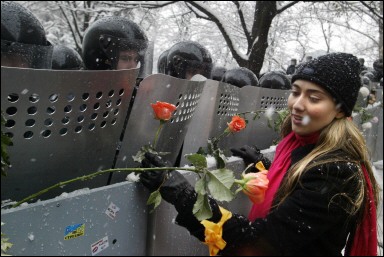
I was seduced by this :


Subsequent events and the general consensus of my peers has made me feel somewhat duped, as far as the innocence and optimism of Yushchenko's campaign for the Presidency of Ukraine - it seems to have been a relatively skillful manipulation of public relations images and information, a cynical thing - so that when I look at this image:


I'm wary of being manipulated again.
Not, this time obviously, by a beautiful young girl so vulnerably putting flowers on the shields of faceless policemen, but by the potent stance and confident faces of what are, presumably, bodyguards for a man who is almost never photographed without a disconcertingly leering smile on his face.
Allawi's always got that smile - his country's a train wreck, the people he's supposedly leading are dying more and more violently every day, yet he keeps on grinning.
It makes him seem evil. I think he probably is evil, in the sense that evil is a selfishness of Satanic proportion. But he's off to the side in the picture isn't he?
Are those soldiers American? Iraqi? The caption says they're U.S. Special Forces.
They don't look like Americans. They look like Israelis. Were they chosen for that reason? Why is that one soldier in the foreground of the image, with his profile being the focal point, the place where the observer's eye is naturally drawn? The photo's "about" him.
Is this more cynical intent? Accident? Co-incidence? Or is it the intention of the photographer to illustrate something more than the simple narrative of "Armed U.S. special forces escort Iraq's Interim Prime Minister, Iyad Allawi (L) following the delivery of a C-130 transport plane to the Iraqi Air Force in Baghdad's International Airport, January 19, 2005."
Is there a viciousness revealed here, in the image, and the faces of the men in the image? I think so. And a statement, a boasting of conquest, an arrogance.
A viciousness so profound it's metaphysical, spiritual, cosmic. Psychotic arrogance achieving complete self-gratification.
That's what it looks like.

The image of Allawi and the Special Forces soldiers is lifted from Rigorous Intuition who quotes its caption with a Reuters byline, but a search of the Reuters site, and a Google web and news search, didn't find it.

Odd Happenings in Fallujah
"The soldiers are doing strange things in Fallujah," said one of my contacts in Fallujah who just returned. He was in his city checking on his home and just returned to Baghdad this evening.
Speaking on condition of anonymity he continued, "In the center of the Julan Quarter they are removing entire homes which have been bombed, meanwhile most of the homes that were bombed are left as they were.
Why are they doing this?"

Dahr Jamail

Burhan Fasa'a - a cameraman with the Lebanese Broadcasting Corporation (LBC) who witnessed the first eight days of the fighting in Fallujah:
"The military called over loudspeakers for families to surrender and come out of their houses, but Burhan said everyone was too afraid to leave their homes, so soldiers began blasting open the gates to houses and conducting searches.

Americans did not have interpreters with them, so they entered houses and killed people because they didn't speak English! They entered the house where I was with 26 people, and shot people because they didn't obey their orders, even just because the people couldn't understand a word of English. Ninety-five percent of the people killed in the houses that I saw were killed because they couldn't speak English."
[...]
"On Tuesday, November 16th, I saw tanks roll over the wounded in the streets of the Jumariyah Quarter. There is a public clinic there, so we call that the clinic street. There had been a heavy battle in this street, so there were twenty bodies of dead fighters and some wounded civilians in front of this clinic. I was there at the clinic, and at 11 a.m. on the 16th I watched tanks roll over the wounded and dead there."
After another long pause, he looked out the window for awhile. Still looking out the window, he said, "During the nine days I was in Fallujah, all of the wounded men, women, kids and old people, none of them were evacuated. They either suffered to death, or somehow survived."
"I saw civilians trying to swim the Euphrates to escape, and they were all shot by American snipers on the other side of the river."

a democrat by example, and a man of peace
Ardeshir Gholipour
Ardeshir Gholipour

-

Mr Gholipour has been held in [Australian] immigration detention since March 2000, having fled Iran earlier that year. International PEN's Writers in Prison Committee based at the organisation's headquarters in London has investigated Mr Gholipour's story and we can confirm the legitimacy of his claims, and that he has real reason to fear persecution for his legitimate and peaceful political activism should he be returned to Iran. His involvement in the Iran Freedom Movement and the Left Union for Democracy in Iran makes him particularly vulnerable to repression.

As a writer, specifically for the Left Union for Democracy's publication, the Payan peroz Research Bulletin, between 1994 and 1997, and for his work for the samizdat newspaper Khaber Nameh, Gholipour has been particularly courageous in his stance against suppression of dissent in Iran. Notably, Khaber Nameh provided reports and commentary on the murders of prominent writers in the late 1990s, for which a number of Iranian officials were later convicted.

One of those murdered was Pirooz Davani, also a writer, and with whom, until his murder in 1998, Gholipour worked closely. Both worked on articles for Khaber that were strongly critical of the Iranian government and called for constitutional change. Information they published included reports of mass graves containing the bodies of dissidents, and implicating the security services in the deaths and the torture of political activists.

This clandestine magazine also published letters from the well known writer, Faraj Sarkoohi, who at that time had been abducted by intelligence services then sentenced to death, subsequently released and now living in exile in Germany. To publish such articles in late 1990s was an extremely courageous and dangerous activity for which Davani paid with his life.

Letter To Senator Vanstone [Aus.] from Dr. Karin Clark, Chair, Writers in Prison Committee, PEN International
-
reprinted at melbourne indymedia
-

Ardeshir Gholipour's art
at Bid For Freedom/The Brigidine Nuns' Asylum Seekers' Project
-
link BARISTA

17.1.05

IN THE CIRCUIT COURT OF SHELBY COUNTY,

TENNESSEE FOR THE THIRTIETH JUDICIAL

DISTRICT AT MEMPHIS

_______________________________________________

CORETTA SCOTT KING, et al,

Plaintiffs,

Vs. Case No. 97242

LOYD JOWERS, et al,

Defendants.
_

Q. Would you state your name and address for the record, please.
A. Leon Cohen. I reside at 1859 Poplar Pines Drive, Number 201, Memphis, 38119.
[...]
Q. Where did you live before that?
A. New York City.
Q. What did you do in New York City?
A. I was a member of the New York City Police Department. For twenty-three years.
[...]
Q. How often would you say you saw Mr. Bailey in an average week or month?
A. Two or three times a week.
Q. And you became quite friendly with him?
A. Yes, I did.
[...]
Q. Right. What did Mr. Bailey do for a living in 1968?
A. He was the owner and the manager of the Lorraine Motel.
Q. The Lorraine Motel, is that the same motel which Martin Luther King came to stay
in Memphis on April 3rd, 1968?
A. That's correct.

Q. Were you familiar with the fact that
Dr. King was coming to Memphis at that time?
A. No. I was not.
Q. When did you learn that Dr. King was in Memphis?
A. I was on my way back from Nashville when I heard the news on the radio about his
assassination. That's the first I knew of him being in Memphis.
Q. That would have been on the 4th of April that you heard this news?
A. Yes, sir.
Q. When did you next see Mr. Walter Bailey?
A. The very next morning.
Q. On the 5th of April you went to see him?
A. No. I went to take -- to look over the scene at the Lorraine Motel, and I took
some photographs while there. After I had taken photographs, I ran into Mr. Bailey.
Q. What time of the morning would that have been?
A. Between eight and nine a.m., as I best recall.
Q. So it was quite early in the morning?
A. Yes, sir.
Q. Actually where did you go to look
over this scene? Where were you? What was your path?
A. Well, I first went to the rooming house where the alleged shots had been fired
and took some photographs from the lavatory of the rooming house aiming towards the
Lorraine Motel. Then I went down and took photographs of the Lorraine Motel and
vicinity. At that time I ran into Mr. Bailey.
Q. And where did you meet Mr. Bailey?
A. Right outside his office.
Q. At the Lorraine Motel?
A. At the Lorraine Motel.
Q. Did you have a conversation with him?
A. Yes, sir, I did.
Q. And what -- how did you perceive him at that time? Was he upset? How did you view him?
A. Well, he seemed visibly upset about the occurrence.
Q. Did you ask him any questions about the incident?
A. I mentioned the terrible occurrence. He said in response, if they had listened to
me, this wouldn't have happened. And he went on to explain that the previous night, he got
a call from a member of Dr. King's group in Atlanta who wanted him to change the location
of the room where Dr. King would be staying. And he was adamantly against that because he
had provided security by the inner court for Dr. King, Dr. King's room.
Q. Where did he want Dr. King to stay in his motel?
A. There was an inner court behind the office which had very good security. In
other words, it was not exposed to public view. Per se.
[...]
Q. And, instead, where did Mr. Bailey say he was being instructed to move Dr. King?
A. The room -- I don't recall the room number, but the room which Dr. King had
occupied that night, that's the room that they wanted him to occupy.
Q. A balcony room?
A. Yes, sir.
Q. For the record, that was Room 306, that balcony room. So Bailey said he was
instructed to move Martin King from room -- well, you didn't know the number, but from a
courtyard room to a balcony room?
A. Yes, sir.
Q. Did he say he opposed that?
A. He adamantly opposed it.
Q. Did he say who in Dr. King's organization wanted him placed in that
exposed balcony room?
A. He just mentioned that a member of Dr. King's group had told him, advised him,
he wanted the room changed. He said he knew the person, but I did not question him as to
who it was or his name or pedigree or whatever.
Q. Did he indicate, when he spoke to you, if you can reflect very carefully, Mr.
Cohen, did he use the pronoun "he" or "she"?
A. He used the pronoun "he."
Q. So some male member of Dr. King's Atlanta office instructed the room change?
A. Yes, sir.
Q. Once again, when did he receive that instruction?
A. He said the previous night that Dr. King was supposed to stay there.
Q. Prior to the arrival?
A. Yes, sir.
Q. Just moving on, when you were down in that area early that morning, did you then or
had you previously had an opportunity or occasion to look at the area behind the
rooming house?
A. No. No, that was the first and last occasion.
Q. Did you look at the area that morning?
A. After the assassination, yes, sir, I did.
Q. How did it appear to you?
A. Which area are you referring to?
Q. I'm referring to the area behind the rooming house above the wall on Mulberry
Street. I could show you -- we have -- can you see this?
A. No, I can't.
[...]
Q. (BY MR. PEPPER) I'm asking you about this area here that is above the wall. There
is a wall here on Mulberry Street. I'm asking you about this area which is behind
the rooming house.
A. Uh-huh.
Q. The rooming house has two wings. There is an alleyway. This is vacant area
fenced in. I'm asking you about this. I just wondered if you had a chance to look at this.
A. Yes, I did, that very same morning I had taken the photographs.
Q. And how did it appear to you? What did you see?
A. Well, it was kind of dense with underbrush.
Q. Dense with underbrush?
A. As a matter of fact, I went to the room which James Earl Ray had occupied and
looked out the window which overlooks the alley and looked out the window intending to
take some photographs, but I never did because they wouldn't have shown anything
outside of the underbrush.
Q. So it was thick underbrush is what you are saying?
A. Yes, sir.
Q. Okay.
MR. PEPPER: Thank you, Mr. Cohen. No further questions.

- * - * - * - *_* - * - * - *- * - * - * - *_* - * - * - *-

transcribed statement of Kaye Pittman Black:

Question: Without telling us exactly what was said, but did you have a
telephone conversation with Mayor Ingram on morning of April the 5th?
Answer: Yes, I did. He called somewhere between I would say seven and ten.
The reason I say seven is most of us had been up all night. A lot of us came in at seven,
some had gone home. So it would have been between seven and ten.
Question: And as a result of that conversation, did you go over to the South
Main Street area?
Answer: Yes.
Question: Where did you go and what did you observe at the South Main Street
area?
Answer: The trees which lined the embankment behind the rooming house and which
would have overlooked the Lorraine Motel had been cut and the area had been cleared and
cleaned.
Question: Would you show us the area where the trees that you are talking
about were located?
Answer: They would have been -- this faces the Lorraine back, the back of the
rooming house, correct?
Question: That's the rooming house. That's the back area of the rooming
house there.
Answer: This is where the embankment would have been where the trees
would have been. It overlooks the Lorraine.
In other words, someone here up in the rooming house would have had to look down to
the Lorraine because the embankment was taller than me, which means, you know, which
I'm not very tall, but it would have been six or eight feet tall. I think it was a
concrete embankment holding up the back of the building.

15.1.05

Blog Archive