why I read boiNgBoiNg, this is really cool progress

informant38
-
...But of these sophisms and elenchs of merchandise I skill not...
Milton, Areopagitica

Except he had found the
standing sea-rock that even this last
Temptation breaks on; quieter than death but lovelier; peace
that quiets the desire even of praising it.

Jeffers, Meditation On Saviors
-
6.9.02
5.9.02
Tomaz Salamun (see also Mary Beth O'Connor)
in Massachusetts Review
GRACE
About God real quick
he never said ampleness
never rosemary
never peaceable
and if there were ants in the corners
there were ants in the corners
let's say the dust
where should it fall
toward down or toward sideways
or should it be the roots
all these things God solves real slow
sometimes he says ARCHAIC
but nobody budges
nobody wakes up
in fact no one wakes up
sometimes he says we killed carriers of flowers
and buys bright paper
I bought bright paper he says
we killed carriers of flowers
and loads
a little barque floats on the sea
trees bend, something falls
it makes a big splash
you are the light of the world
a city on the hill cannot hide
still here 00:39
4.9.02
If you still somehow manage to use the wrong one, no one will notice. Anyone watching you to see which fork you�ll use is just trying to figure out which fork they should use, which is really rather sweet.
- Margaret Berry in The Morning News(above)
still here 20:01
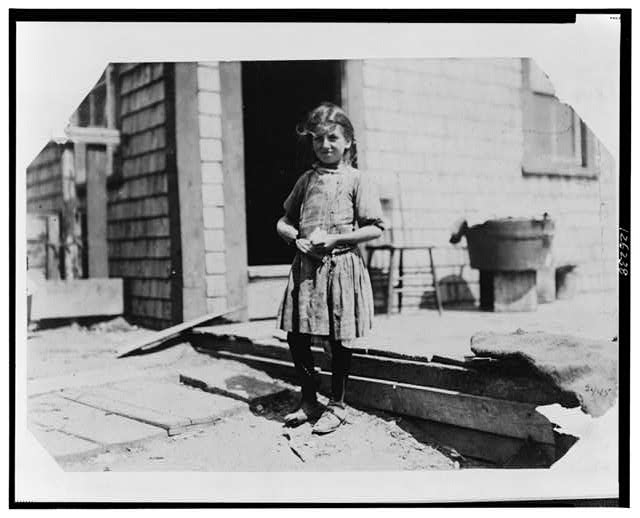
Phoebe Thomas, eight-year-old Syrian girl, full-length portrait, standing outside of house, a little while after accident, in which she had cut the end of her thumb nearly off in factory, Eastport, Maine
still here 16:56
links to the Hugo Award Nominees 2002
and Spider Robinson's Melancholy Elephants from the book By Any Other Name, 5 stories of which are online.
link via that bOINgBoinG(above)
still here 15:01
MIT team probes arsenic and old lakes.
The two researchers emphasize the significant contributions of earlier students and other faculty. "I came in after a lot of people had already done much work to identify the major questions to ask," Senn said.
still here 01:08
2.9.02
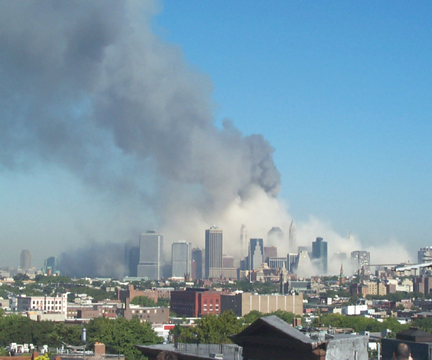
In the wake of the September 11 terrorist attack, people tell me over and over that they don�t feel safe. One friend buys a gas mask, several buy guns. One stocks up on toilet paper. These people live thousands of miles from NYC. I was born there. As a child, I dreamed obsessively of Manhattan bombed from the air. The Cuban Missile crisis found my third grade class hiding beneath our desks. I was raised in a household where the words "Hiroshima" and "Auschwitz" were as common as "salt� and "potato." My grandmother had been in a pogrom. The little girl next to her had been killed by horsemen. The town I grew up in New Jersey had the third highest property damage from riots in the nation. We could hear gunshot from our front porch�this in a gracious upper middle class neighborhood. My friend Sandy was locked in the house during the riots�her dog had escaped, she was very worried. I went to her Black Baptist church with her. The house next door to mine burned to the foundation. My parents were away. I sat up with my Russian grandfather, watching to see the trees didn�t burn. I was 13 years old. Our phone was tapped�a legal tap�click click click. My father was arrested because of his anti-war activities. His taxes were audited every year. He was on Nixon�s enemies list. Safe is not a word I would apply to my sense of reality. I was raised to believe that history would kill me, it was best to try and stay out of the way. During the war in Bosnia I looked every day at my neighbors�a different class, religion, and ethnicity than I. Our mutual walls supported many apricot trees. They were the pleasantest of people. Every day I was glad they weren�t trying to rape and kill me, or cut down my fruit trees. An odd way to live, perhaps, but my frame of reference. When I heard the news on September 11 I did say aloud: this is the worst thing that has happened in my life time in America. I cried for hours�after all, a New York accent means something to me. I won�t put a hierarchy on suffering�this was the suffering of the day, enough to buckle our knees, weep us dry. But I felt no less safe the next day than the day before. I grew up with hurricanes and blizzards. I had enough toilet paper.
still here 19:25
In a speech in Maputo, Mozambique, delivered 12 hours before arriving in Johannesburg for the earth summit, Mr Blair made combating climate change his major theme and reiterated his support for the Kyoto agreement to reduce greenhouse gases, a course Mr Bush has rejected.
This was a calculated rebuff to the American president, who, having repudiated the Kyoto agreement, has instructed his team at the earth summit to remove all mention of it from the final 30,000-word "plan of action" being negotiated there.
Mr Blair, aware of the US pressure to "lose Kyoto", decided to embarrass Mr Bush by emphasising its importance.
But what makes it the more surprising is that his aides appeared to be emphasising the split with Washington. Last night the strategy was being seen as a clear attempt to demonstrate to a home audience that Britain is not slavishly loyal to the United States.
from GuardianUK via floating wreckage(above)
still here 14:56
1.9.02
An Islamic high court in Nigeria upheld the death-by-stoning sentence of Amin Lawal, a single mother convicted of having sex out of wedlock. The court delayed the execution until January 2004, when she will finish breast-feeding her baby--unless, of course, the baby does something to piss them off.
still here 18:54
Victims in the case said they felt they had been denied justice at every turn. Some members of Unit 731 became pillars in the Japanese medical and business communities after the war and were never prosecuted; in fact, they held regular reunions.
The United States made a secret deal to exempt the biological war crimes from the Tokyo trials held after the war, in exchange for the results of the gruesome experiments. The Japanese government denied the existence of the deal and the secret unit for years, and still insists in the face of journals, documents and testimony that it doesn't know what the unit did. Nationalist historians have gained increasing acceptance for accounts that diminish or omit the army's use of biological and chemical weapons against the Chinese.
from washintonpost.com
"Its main purpose was to research, develop and produce biological weapons,'' said the ruling. "In order to do this, prisoners from the Chinese resistance forces were used as the subjects for experiments.''
During the five-year court case, Unit 731 veterans confessed to carrying out vivisections on humans; cultivating anthrax, typhoid, cholera, and other pathogens; and dropping plague-infected fleas over villages.
....
Elderly plaintiffs flew in from China and testified -- often in tears -- about their communities being ravaged by diseases that spread mysteriously after Japanese war planes had flown low and dropped wheat, rice or cotton infested with fleas.
After the war, the Japanese Army burned most of the facilities used by Unit 731. The United States granted immunity to Ishii and his colleagues in return for their research findings, and the unit was not mentioned during the Tokyo War Crimes Tribunal...
from mercurynews
see also
- this
- this
- this
- and this
- further research on Unit 731 at the thorough links page of CalState Sacramento Social Studies
- research also Dr. Norbert Fell, Lt. Col. Arvo Thompson. Thompson arranged the transfer of data to US interests and immunity from prosecution for Unit 731 Japanese military, then suicided in 1948.
- and then on to Korea
- and the resolute Chinese Holocaust Museum
no. all regrets but no.}
still here 12:46
Subscribe to:
Posts (Atom)
Blog Archive